About Conference
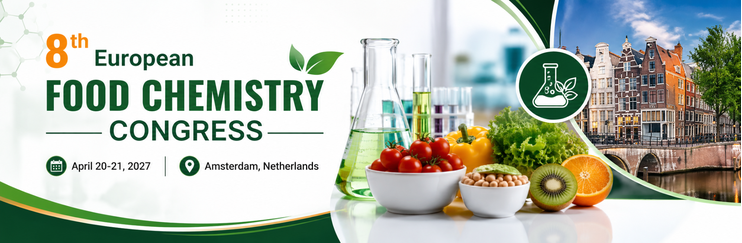
The 8th European Food Chemistry Congress will be held on April 20–21, 2027, in Amsterdam, Netherlands, bringing together food chemists, researchers, scientists, academicians, nutrition experts, industry professionals, and policymakers from around the world. The congress will provide an international platform to exchange knowledge, present innovative research, discuss emerging trends, and explore recent developments in food chemistry and related scientific disciplines. Participants will have opportunities to engage in meaningful scientific discussions, build professional networks, and establish collaborations across academia, research, and industry.
The Food Chemistry Congress-2027 will highlight contemporary developments in food chemistry, including food analysis, food safety, bioactive compounds, functional foods, food processing, nutrition, food additives, natural products, analytical techniques, and emerging food technologies. Through keynote presentations, invited talks, oral and poster sessions, and interactive discussions, the congress aims to encourage scientific collaboration and knowledge sharing. Hosted in Amsterdam, a renowned European center for science, culture, and innovation, the 8th European Food Chemistry Congress offers an inspiring setting for researchers and professionals to connect, share discoveries, and contribute to the future of food science and chemistry.
Benefits of Attending
Attending the 8th European Food Chemistry Congress, April 20–21, 2027 in Amsterdam, Netherlands, provides an opportunity to connect with researchers, academicians, food scientists, industry professionals, and innovators working across food chemistry and related disciplines. The benefits can be presented on your website as follows:
-
Explore Latest Research – Gain insights into emerging developments, discoveries, technologies, and methodologies in food chemistry and food science.
-
Global Networking – Connect with researchers, academics, industry experts, and professionals from different countries to exchange ideas and build lasting professional relationships.
-
Share Knowledge & Ideas – Participate in scientific discussions, presentations, and interactive sessions that encourage knowledge exchange and interdisciplinary collaboration.
-
Research Feedback – Present your research and receive constructive feedback, new perspectives, and suggestions from experienced professionals and peers.
-
Discover Industry Innovations – Learn about emerging technologies, analytical methods, sustainable practices, food safety solutions, and product innovations shaping the food sector.
-
Build Research Collaborations – Identify opportunities for joint research, academic partnerships, industry collaborations, and future scientific projects.
-
Enhance Professional Skills – Strengthen presentation, communication, scientific networking, and knowledge-sharing skills through interaction with experts.
-
Stay Ahead of Trends – Understand current and emerging directions in food chemistry, food safety, functional foods, sustainability, processing, analytical technologies, and nutrition.
-
Increase Professional Visibility – Showcase your research, expertise, and achievements to an international audience of food science and chemistry professionals.
-
Support Innovation & Sustainability – Exchange ideas on innovative approaches to food quality, safety, sustainable processing, waste valorization, and healthier food systems.
Sessions/Tracks
Track 1. Food Chemistry & Molecular Science
Explore the chemical composition of foods, molecular interactions, bioactive compounds, and fundamental principles governing food quality, functionality, and stability. Discuss recent advances in molecular characterization, food constituents, chemical reactions, and interactions occurring during food preparation and storage. Discover how molecular-level research can support the development of safer, healthier, and more innovative food products.
Track 2. Food Analysis & Analytical Techniques
Discuss advanced analytical methods for identifying, characterizing, and quantifying food components, contaminants, additives, and bioactive substances. Explore modern instrumentation, spectroscopy, chromatography, mass spectrometry, and other analytical approaches used in food research. Learn how improved analytical technologies contribute to food authenticity, quality control, and accurate compositional assessment.
Track 3. Food Safety & Toxicology
Focus on chemical and biological hazards in the food chain, food contaminants, toxic substances, risk assessment, and innovative approaches to ensuring food safety. Examine emerging foodborne hazards, mycotoxins, pesticide residues, heavy metals, processing contaminants, and methods for their detection. Discuss strategies for minimizing risks and strengthening food safety throughout production, processing, and distribution.
Track 4. Functional Foods & Nutraceuticals
Explore the development and scientific evaluation of functional foods, nutraceuticals, bioactive ingredients, and their potential benefits for health and well-being. Highlight research on antioxidants, probiotics, polyphenols, peptides, vitamins, minerals, and other health-promoting food components. Discuss current approaches to developing evidence-based functional food products and understanding their biological effects.
Track 5. Food Processing & Preservation
Examine modern food processing and preservation technologies designed to improve shelf life, maintain nutritional quality, enhance safety, and preserve sensory characteristics. Cover innovative processing approaches such as high-pressure processing, fermentation, drying, freezing, thermal technologies, and non-thermal processing. Explore how processing conditions influence food chemistry, nutritional value, texture, flavor, and overall product quality.
Track 6. Food Additives, Flavors & Ingredients
Cover research on food additives, natural and synthetic flavors, colors, sweeteners, preservatives, emulsifiers, and innovative ingredients used in modern food production. Explore the functionality, safety, stability, and regulatory aspects of ingredients used to improve food quality and consumer acceptance. Discuss emerging natural alternatives and clean-label ingredients responding to changing consumer preferences.
Track 7. Nutrition, Bioactive Compounds & Health
Discuss the relationship between food composition, bioactive molecules, dietary components, and human health, with emphasis on nutritional quality and emerging food-health research.
Explore how nutrients and bioactive compounds interact with physiological processes and contribute to healthy dietary patterns. Highlight innovative research connecting food chemistry with nutrition, disease prevention, metabolism, and human well-being.
Track 8. Sustainable Food Chemistry & Green Technologies
Highlight sustainable approaches to food production, green chemistry, waste valorization, resource efficiency, circular food systems, and environmentally responsible processing technologies. Explore methods for reducing food waste, energy consumption, water usage, and environmental impact across the food supply chain. Discuss innovative opportunities for converting food by-products and waste streams into valuable ingredients and bioactive compounds.
Track 9. Food Packaging & Emerging Technologies
Explore innovative packaging materials, active and intelligent packaging, nanotechnology, smart technologies, and approaches for improving food protection, quality, and shelf life. Discuss the interaction between packaging materials and food components, including migration, stability, safety, and sustainability considerations. Examine emerging biodegradable, recyclable, and functional packaging solutions for the future food industry.
Track 10. Food Biotechnology & Future Innovations
Examine emerging applications of biotechnology, fermentation, enzymes, precision technologies, alternative proteins, and other innovations shaping the future of food science and chemistry. Explore how biotechnology can support sustainable production, improve nutritional profiles, enhance food functionality, and develop novel food ingredients. Discuss future trends and breakthrough technologies expected to transform food chemistry and the global food industry.
Market Analysis
The European food and drink industry represents a major global market, generating approximately €1.5 trillion in turnover and €300 billion in value added, while employing around 4.8 million people across the EU. The food chemistry sector is benefiting from increasing demand for functional and natural ingredients, clean-label formulations, advanced analytical technologies, food safety solutions, and innovative processing methods. The European specialty food ingredients market is estimated at USD 30.36 billion in 2026 and is projected to reach USD 39.43 billion by 2031, reflecting continued demand for healthier, functional, and technically advanced food solutions.
Sustainability, nutrition, food safety, and technological innovation are expected to remain key priorities for the European food sector through 2027. Growing interest in functional foods, plant-based products, protein-rich formulations, sustainable packaging, and transparent ingredient sourcing is creating new opportunities for researchers and industry professionals. At the same time, strict European requirements for contaminants, packaging materials, and food safety are encouraging investment in advanced analytical methods and safer technologies. Against this backdrop, the 8th European Food Chemistry Congress, taking place in Amsterdam on April 20–21, 2027, provides a timely platform for researchers, academics, food scientists, manufacturers, and technology experts to exchange knowledge and explore emerging opportunities across the evolving European food chemistry market.